In January Alex, Paola Torres Núñez del Prado and Dave were invited by our long term collaborator and friend Julian Rohrhuber to visit the Institute for Music and Media (IMM) in Düsseldorf to expand on our previous work together with Andean Khipu.
The theme for the workshop was a bit broader than knotted string records:
When speaking of “formalisms”, we mostly think of formulas written in a symbolic text. When speaking of “the necessary formalities”,however, we know that we may not only write, but also act formally.
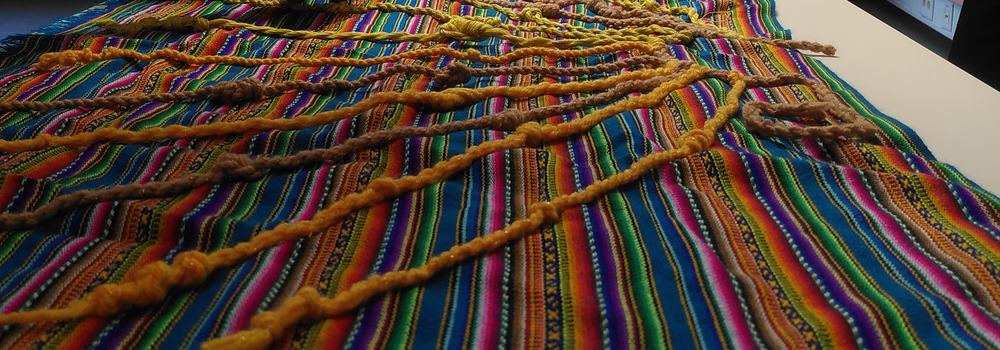
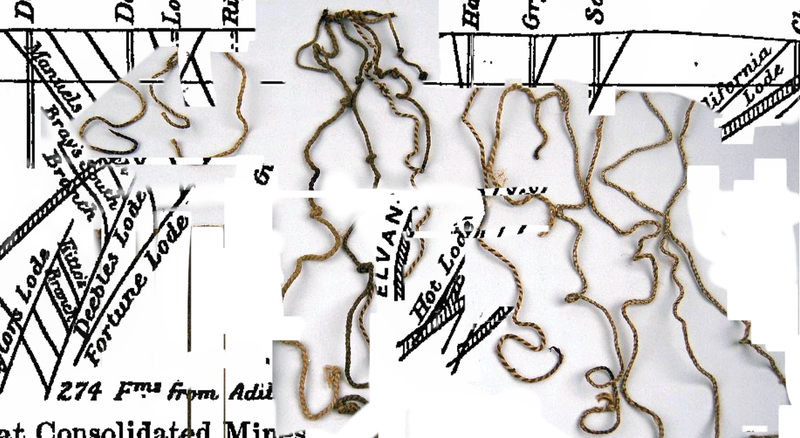
If we look beyond the knots, Khipu represent a necessary part of every day Inca life (and other Andean civilisations too), recording ownership, obligations and debt. As we have written before, it's important to escape the trap of observing these artifacts as exotic remnants of a distant world. One way we can do this is put them alongside other formalisms in a similar context. We introduced the labour value systems and recording methods used by miners in Cornwall in the 18th and 19th century, bringing in some of the research we have been doing for the Organised Atoms project. We included a session making our own khipu, and learning how the construction and tying together of strands, pendants and knots provides its own form to guide and develop our thinking.
Setup
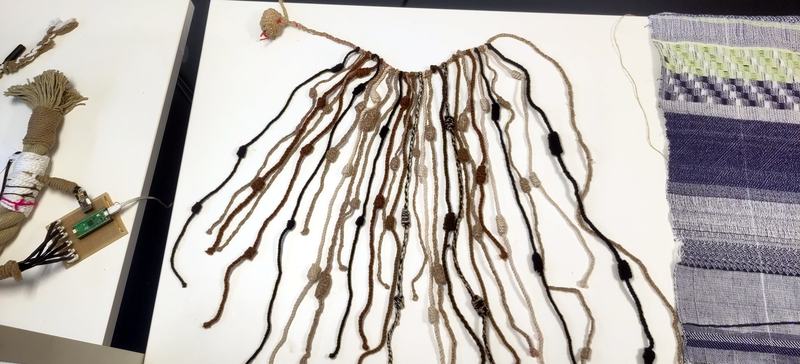
We some examples of khipu laid out on separate tables:
- Paola's Andean khipu from Tupicocha, and some of her personal khipu artworks
- Alex's weave knot transcription khipu tied to the weaving it created
- Our pluggable knots interface and robots dancing on the floor
We also had a separate large table for working around with a selection of colours of merino yarn for making khipus, power for laptops and a projection screen.
Process
To begin with people gathered for coffee and tea, played with the robots and the pluggable knots before any introduction to the topics. Paola started us of by talking about the purpose and use of khipu in Andean culture followed by inviting the participants to investigate each of our three examples of khipu, without any further prompting.
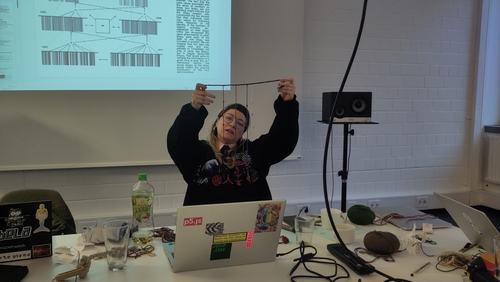
Once they had finished looking at and playing with the khipu we had a discussion on their own interpretations and imagined meanings behind the knots, design choices and yarn colours. Alex, Paola and Dave then took turns to describe each one from their perspective, as the makers or people with knowledge of these specific khipu. We then had a bit of a further discussion, followed by a khipu making session where the discussions blended into the plying and knotting activities.
As a final step we plunged into the world of Cornish mining, looking at the connections not only with the formalities of their labour systems, but the legacy of these practices today. Peru is one of the main producers of copper and other minerals with varying degrees of exploitation that can be traced back to their origins in the Cornish mining industry at the start of the industrial revolution.
Thoughts regarding pluggable knots.
One of our khipu contributions to the workshop was our experimental 'pluggable knots' which program woven robots over radio, controlling how they move and dance together. We've been using this quite bit recently in workshops and public events so we are trying to use these situations as a way to improve and develop them.
As they were set up and running right at the start, people were drawn to them as they took up a bit of the attention while people gathered and made tea. It was useful at the beginning to have them as an immediate introduction to the concept of 'knots meaning something'. As they are tied in rope, they are almost comically large compared to the other khipu - but they did serve as a good way to demonstrate the different types of knots - as it's a bit eaiser to tell how they are tied and copy them, rather than with thinner yarn.
By accident more than by design - there were no explanations of the knot meanings like we've had before (in the form of a large drawing). This seemed to work better in some ways, also as we couldn't actually remember all the meanings, it made it a shared process of discovery which is always better. We added flags to the robots and corresponding letters to the sockets to remove some of the guesswork of which knots were controlling which (which is less interesting guesswork than the knot meanings).
Problems that came up included that some of the knots (e.g. the ones that change the speed) don't have an immediate effect on the robot. This means if they are the only one in the network the robot doesn't actually do anything, so people aren't sure if it's working. We need to remap the knots to the code changes to fix this somehow. Less interesting, but we also have a bug where the radio seems to stop sending messages after about twenty minutes, needing a quick reset to fix it.
Conclusions
I think that bringing in other contexts such as Cornish mining can help to break down stereotypical thinking, but we need to work a little more on the best way to do this. I think it certainly improves on comparing khipu to bare computational concepts (e.g. "Inca harddrives"), partly as this can tend to be taken on a metaphorical level. We can move instead to thinking about the people involved and their social organisation. I think if we can do this well, it can help to confront the colonial elephant in the room when discussing Andean peoples, by bringing in the notion that the colonisers also had their own history, and that their practices of exploitation used on the South American continent and elsewhere came from somewhere. It was all too simple to transfer the logic of exploitation of labour value from their own people to others.
The participants were really interesting to work with, bringing in their own experience and thoughts, and quite happy to be confronted with such a variety of concepts. The khipu tying was a good way to add activity and making things into an otherwise in depth conversation. The plying particularly was taken to with great enthusiasm, at one point by dangling and spinning a drop spindle spanning multiple floors outside the building!