
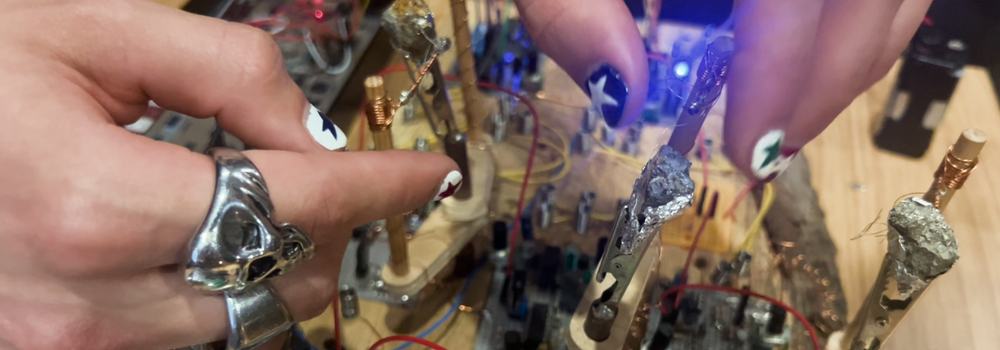
Up until now, Organised Atoms workshops have been things we've done with families at abandoned mines - we have been very locked to these locations, where we look for crystals in piles of mine waste dumps, often right next to the mine shafts they were hauled out of hundreds of years before. At the same time, during each workshop series we've run we've been contacted by musicians and artists who've wanted to get involved - but we haven't been able to cater for them properly, as the funding hasn't really been provided for that purpose.
A while back I had a chat with Simon Waite (National Trevor) from Falmouth University about the possibility of doing an Organised Atoms workshop with their music students. My main concern was maintaining the mining aspects (smashing the rocks) as well as the more institutionally compatible elements like circuit building. Luckily they have a workshop on site run by Ryan Hollywood, which gave us the opportunity to do some micro mining activities in a place with plenty of gloves, eye protection and extremely durable tables! I took along a couple of buckets of heavy, mineralised rocks from various sites (mostly Nangiles mine, Ale & Cakes and Wheal Fortune - all in the Gwennap area) and I told them they could keep any of the crystals they could find... it didn't take long until the room was filled with hammering and flying shards of metamorphic rock.
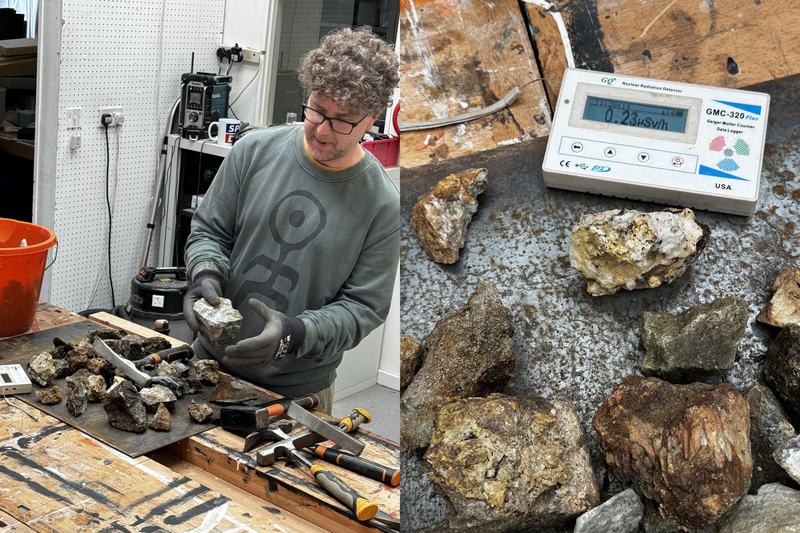
While this was all good stress reducing therapy, there are observations that you can make of the nature of our planet that you can only get with this sort of hands on activity. The physical properties of the material, and the way it breaks can tell you a lot about how it was formed. The granular crumbly granite vs the extremely hard microcrystalline quartz which sparks when you hit it - the weak metamorphic slate which doesn't really contain anything of interest, compared with the well formed clear quartz which splits along the joint faces that often contains impressive veins of pyrite, chalcopyrite and sphalerite.
Once each student had collected a couple of handfuls of material and we'd all grown tired of hammering (buckets of previously good size rocks now partly reduced to fine gravel!) we moved to a studio in their performance centre where we could talk about the wider context of this activity, conflict mining, externalities in AI 'technology', and the invention of the transistor.
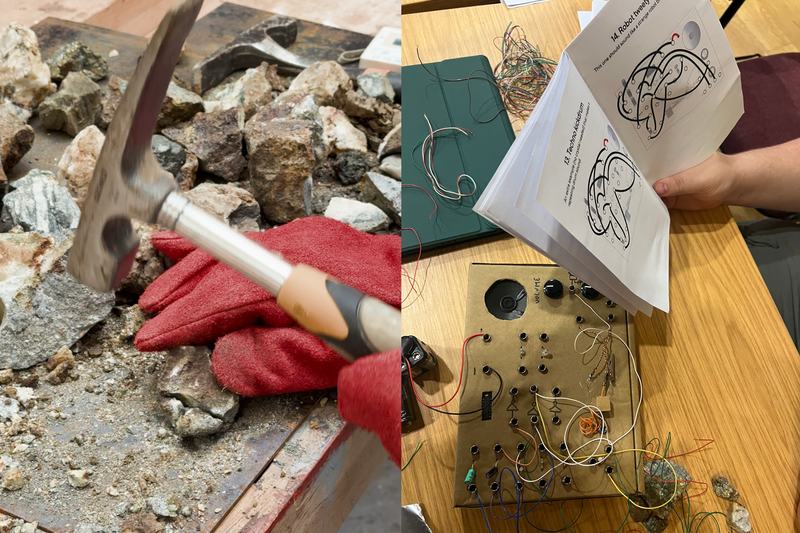
We then introduced the cardboard crystal synths we had left over from our Royal Society of Chemistry events, handed out wires, tin foil and batteries and they started working through the example circuits. A big thing that became apparent was that making a wide variety of sounds from such simple circuits offered a very different approach to the mostly screen based production methods that the students were used to.
To expand on the types of noises possible, we got the crystal log synth going (plugged into their large PA system) for a more collaborative sound exploration exercise. Will Parker (mono-on) helped set this up so they could record the session so they could use the audio material later on in their work. The students could connect their crystals up to the pre-made oscillators, filters and sequencer circuits - some combined two different crystals to see how that sounded, something I've never thought of doing but is actually how a lot of semiconductors are built.
This workshop was an important test for this project - seeing how it could work with adults in a creative way has been something we've wanted to try for some time as there seems to be a demand for this. The interest we've received has had an international angle, places far from Cornwall's mines - so the concept of taking the mine to them, and seeing how you can still develop this physical connection with earths processes separated from the mine shafts and derelict engine houses was surprisingly apparent. One of the first questions asked was how old the rocks were - and an observation that we were the first people to see the beautiful structures and colours they contain hundreds of millions of years after they solidified, and by extension of course, the first people to hear the noisy sonifications of their unique atomic patterns.
Thanks to Si and Will for the photos!